Best Air Coolers Under $50 in 2026

As an Amazon Influencer, we earn from qualifying purchases you might make if you click any of the links or buttons on this page.

The short answer: for most gaming PCs under this budget, buy the Thermalright Phantom Spirit 120 SE if your case has at least 154mm of CPU-cooler clearance. Buy the Assassin X 120 Refined SE when you want the cheapest sensible tower cooler, the Peerless Assassin 120 Mini when case height is the problem, and the Royal Pretor 130 when you genuinely need maximum air-cooling performance and its current price is still $50 or less.

Last reviewed: August 29, 2026

The biggest mistake when shopping for a cheap CPU cooler is choosing one from the TDP number printed on the box.

Cooler manufacturers do not all define those ratings in the same way, and your processor does not create the same thermal load while gaming as it does during an hour-long all-core render.

Under $50, I would make a cooler pass four checks before I care about anything else: case height, RAM clearance, socket support and the amount of cooling your actual CPU and workload need.

Best overall Phantom Spirit 120 SE
Cheapest sensible Assassin X 120
Only 135mm tall PA120 Mini
Max cooling ≤ $50 Royal Pretor 130
Affiliate disclosure: Some links below are paid affiliate links. If you buy through them, Best Motherboard Zone may earn a commission at no extra cost to you. As an Amazon Associate I earn from qualifying purchases.

Table of Contents

The best air coolers under $50 in 2026

Thermalright Assassin X 120 Refined SE CPU cooler
Best Cheap Cooler

Thermalright Assassin X 120 Refined SE

The inexpensive single-tower option I would use for a budget Ryzen 5, Core i5 or stock-cooler replacement rather than paying for cooling capacity the CPU will not use.

  • 148mm tall, 4 heatpipes, one 120mm fan
  • AM4/AM5 and LGA1700/LGA1851
  • Much easier to work around than a large dual tower
  • Main catch: less headroom for sustained high-power workloads
Thermalright Peerless Assassin 120 Mini Black CPU cooler
Best for Limited Cooler Height

Thermalright Peerless Assassin 120 Mini

The smart middle ground when a 154–158mm tower will not fit but your case can still accept a 135mm cooler.

  • 135mm tall, 6 heatpipes, compact dual tower
  • One 120mm PWM fan
  • Far more cooling surface than a tiny 47mm low-profile cooler
  • Main catch: short does not mean narrow; motherboard and RAM clearance still matter
Thermalright Royal Pretor 130 CPU air cooler
Maximum Cooling If $50 or Less

Thermalright Royal Pretor 130

The performance pick when you have a hotter processor or sustained all-core workload and the current price still keeps it inside this guide’s $50 ceiling.

  • 158mm tall, 6 heatpipes
  • 120mm + 130mm 28mm-thick PWM fans
  • Exceptional tested performance for an air cooler
  • Main catch: overkill for many CPUs and no longer a pick if its price exceeds $50

Compare the best CPU air coolers under $50

Swipe → to see the full comparison

Cooler Height Design Heatpipes Fans AM5 LGA1851 Best use Check
Phantom Spirit 120 SE 154mm Dual tower 7 2 × 120mm Yes Yes Best for most builds
Assassin X 120 Refined SE 148mm Single tower 4 1 × 120mm Yes Yes Cheapest sensible upgrade
Peerless Assassin 120 Mini 135mm Compact dual tower 6 1 × 120mm Yes Yes Height-limited cases
Royal Pretor 130 158mm Dual tower 6 120mm + 130mm
both 28mm thick
Yes Yes Maximum cooling ≤ $50

Use this rule

Normal gaming PC with enough room: buy the Phantom Spirit 120 SE.

Cheap Ryzen 5/Core i5 build: buy the Assassin X 120 Refined SE.

Your case cannot fit a normal 150mm-plus tower: see whether the 135mm Peerless Assassin 120 Mini fits before dropping all the way to a true low-profile cooler.

Hot CPU, heavy all-core work and Royal Pretor ≤ $50: buy the Royal Pretor 130 if the case has at least 158mm of real clearance.

Check whether the cooler actually fits before ordering

Cooler height is only one part of the compatibility check. Large air coolers can interfere with tall memory, motherboard heatsinks and the case side panel.

Start Here

CPU Cooler Compatibility Calculator

Enter your processor, cooler, case-height limit, RAM-clearance concern and workload to check whether the cooler class and physical fit make sense together.

Check CPU cooler compatibility →
Full Case Check

Case & GPU Fit Calculator

Use this when the same build also has a large GPU, front radiator or compact case and you want to verify the cooler-height limit alongside the rest of the components.

Check the complete case fit →

Stop buying CPU coolers by their claimed TDP rating

A cooler’s advertised TDP number can look like an easy way to decide whether it is strong enough.

The problem is that there is no single universal cooler-TDP rating system used identically by every manufacturer.

A “200W” label from one company is not automatically equivalent to a “200W” label from another.

CPU behavior also changes with:

  • the processor architecture,
  • power limits,
  • voltage,
  • boost behavior,
  • contact quality,
  • case airflow,
  • ambient temperature,
  • and the actual workload.

Independent wattage tests are not universal TDP ratings either

Reviewer results are useful because coolers are tested under controlled conditions.

But a cooler handling a certain wattage on one test bench does not mean every CPU consuming that same wattage will run at the same temperature. Use benchmark results to compare products tested with the same methodology—not as a replacement number to print on a cooler box.

The four picks in detail

Best air cooler under $50 for most people

1. Thermalright Phantom Spirit 120 SE

154mm Tall Dual Tower 7 Heatpipes 2 × 120mm Fans AM4 / AM5 LGA1700 / 1851
Thermalright Phantom Spirit 120 SE dual tower air cooler product photo

This is where budget air cooling stops feeling like “budget cooling.”

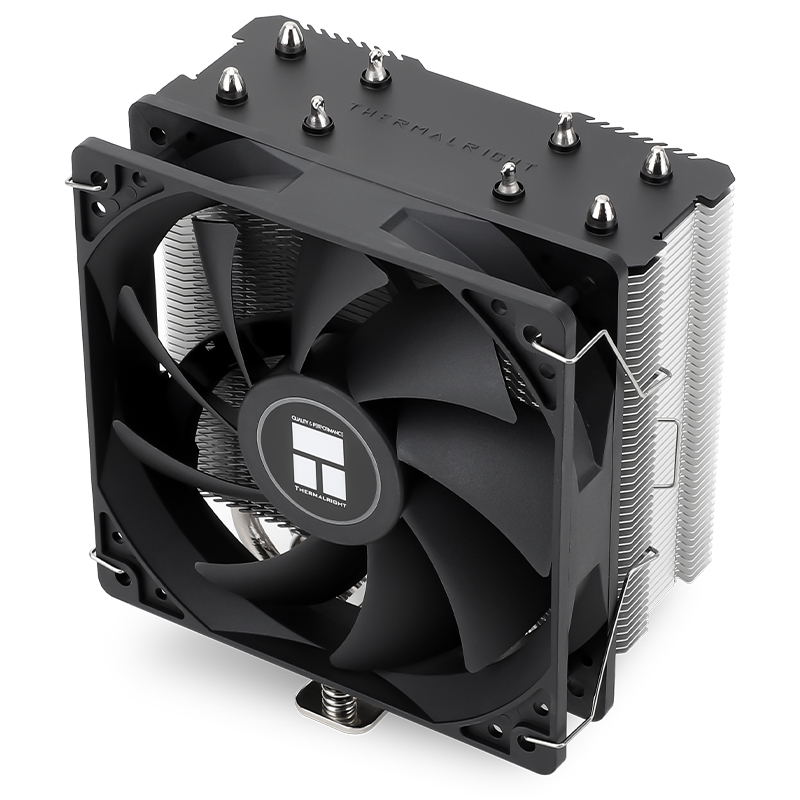
The Phantom Spirit 120 SE uses two heatsink towers, seven 6mm heatpipes, a nickel-plated copper base and two 120mm fans.

The entire heatsink is only 154mm tall, which is a useful advantage over several full-size 157–160mm dual towers.

Thermalright currently lists direct mounting support for AM4, AM5, LGA115x, LGA1200, LGA1700 and LGA1851.

That makes it easy to recommend across a wide range of current Ryzen and Intel gaming builds.

What independent testing tells us

Tom’s Hardware tested the closely related standard Phantom Spirit 120, not the exact 120 SE.

That seven-heatpipe model handled 224W in Tom’s noise-normalized 38.2 dBA test and averaged 234W at full fan speed while producing 41.9 dBA.

I would treat those as evidence of how capable the Phantom Spirit family can be—not as an exact benchmark result for the shorter SE model.

For gaming, a good Ryzen 5, Ryzen 7, X3D processor or sensible Core i5/Core i7 configuration usually does not need anything more elaborate if the case airflow is decent.

Its main weakness is physical size.

The towers sit around the memory area, and a front fan can become a problem with very tall RGB RAM.

Raising that fan to clear memory can also increase the effective installed height above the nominal 154mm.

Buy it if: your case comfortably clears 154mm, your RAM fits, and you want enough cooling headroom that a future CPU upgrade probably will not force another cooler purchase.

Skip it if: your CPU is low-power and budget is everything, or the case/RAM layout makes a large dual tower awkward.

Cheapest air cooler I would use in a normal gaming build

2. Thermalright Assassin X 120 Refined SE

148mm Tall Single Tower 4 Heatpipes 1 × 120mm Fan AM4 / AM5 LGA1700 / 1851
Thermalright Assassin X 120 Refined SE single tower CPU cooler

Not every processor needs two fin towers and two fans.

The Assassin X 120 Refined SE is the option I would use when the goal is simply getting away from a noisy or weak stock-style cooler without spending more of the build budget than necessary.

It is a conventional single-tower design with four 6mm heatpipes and one 120mm PWM fan.

At 148mm tall, it also fits some cases that reject taller 154–160mm enthusiast towers.

The inexpensive cooler is genuinely capable

Tom’s Hardware tested the Assassin X 120 R SE, the closely related entry-level Thermalright model, and it dissipated an average of 213W during the reviewer’s 38.9 dBA noise-normalized test.

Tom’s still specifically warned against treating it as an overclocking cooler. The useful takeaway is not “213W means every 213W CPU is fine”; it is that this very inexpensive single tower performs far above stock-cooler territory.

This is where I would start for an efficient Ryzen 5, mainstream Core i5, older AM4 gaming build or similar moderate-power processor.

I would not deliberately pair it with a hot flagship CPU that spends hours rendering at raised power limits merely because the mounting bracket physically fits.

Buy it if: you want a low-cost stock-cooler replacement, have a moderate-power CPU and would rather put the saved money into the GPU, SSD or RAM.

Skip it if: the Phantom Spirit costs only slightly more when you buy and your case has room for the larger cooler.

Best cooler under $50 when case height is limited

3. Thermalright Peerless Assassin 120 Mini

135mm Tall Compact Dual Tower 6 Heatpipes 1 × 120mm Fan AM4 / AM5 LGA1700 / 1851
Thermalright Peerless Assassin 120 Mini Black CPU cooler

The Peerless Assassin 120 Mini solves a very specific problem: your case is too short for a normal tower, but it is not so short that you need a tiny low-profile heatsink.

Thermalright compresses a six-heatpipe dual-tower design into only 135mm of height and cools it with one 120mm fan.

That 19mm reduction versus the Phantom Spirit SE can make the difference between closing the side panel and returning the cooler.

The performance tradeoff is measurable

GamersNexus measured the Peerless Assassin Mini at 59°C over ambient during its 123W noise-normalized test.

The full-size Peerless Assassin reached 54°C over ambient in the same test.

That is the compromise working exactly as expected: the Mini gives up some cooling in exchange for fitting into cases that cannot accept a conventional tall tower.

What I would not do is see a 145mm case limit and immediately jump all the way down to a 47mm low-profile cooler.

Low-profile cooling is valuable when the chassis demands it, but giving up another 80mm of heatsink height unnecessarily usually means more temperature or more fan noise.

135mm tall does not mean “fits everything”

The Mini is still 125 × 110mm around the socket. Check motherboard heatsinks, RAM placement and case geometry, not just the one height number.

Buy it if: your case cannot fit a 150mm-plus tower but can accept 135mm, and you want to preserve as much air-cooling performance as that chassis allows.

Skip it if: your case easily takes a Phantom Spirit or full-size Peerless Assassin; the extra heatsink volume is useful.

Maximum air-cooling performance if the price remains under $50

4. Thermalright Royal Pretor 130

158mm Tall Dual Tower 6 Heatpipes 120mm + 130mm Fans 28mm-Thick Fans AM5 / LGA1851
Thermalright Royal Pretor 130 high performance CPU air cooler

The Royal Pretor is not my default recommendation because most CPUs do not need this much cooler.

It earns a place here because when its street price remains at or below $50, you can buy genuinely flagship-class air-cooling performance without a flagship price.

Thermalright uses six 6mm heatpipes, a nickel-plated copper base and two unusually thick 28mm fans: one 120mm and one 130mm.

The heatsink is 158mm tall, so the case requirement is stricter than it is for the 154mm Phantom Spirit SE.

This is the strongest independently tested cooler here

Tom’s Hardware measured 243W dissipated in one noise-normalized Intel test, matching a budget 360mm AIO in that specific test.

In a separate Ryzen 9 9950X3D noise-normalized test with GPU heat added to the case, it still handled more than 199W.

At a lighter 140W CPU-only load, Tom’s measured 60.9°C at about 40.3 dBA.

Those results are why I treat this as the max-cooling pick, but they do not mean every $50 build needs one.

The price is part of the recommendation

If the Royal Pretor costs more than $50 when you buy, it no longer wins this category. Go back to the Phantom Spirit and compare the next performance tier rather than quietly expanding the budget.

Buy it if: your processor actually runs sustained heavy workloads, you prefer air cooling, the case clears 158mm and the current price is still $50 or less.

Skip it if: you have a modest 65W-class CPU or a gaming workload that the Phantom Spirit already handles easily.

Why not just buy the Peerless Assassin 120 SE?

You absolutely can.

In fact, Tom’s Hardware’s current 2026 cooler guide names the Peerless Assassin 120 SE its best air cooler for most people.

It remains one of the strongest alternatives in this price range: six heatpipes, two 120mm fans and proven high-end value.

I still give the Phantom Spirit 120 SE the top position here because it gives you seven heatpipes in a 154mm-tall package and is usually priced in the same broad budget class.

This is not a case where one product destroys the other.

Use current pricing as the tiebreaker

If the Peerless Assassin 120 SE is noticeably cheaper when you buy, it is an excellent substitute. If the two are close, I would take the Phantom Spirit 120 SE.

Which cooler should you pair with your CPU?

Efficient Ryzen 5 / Core i5

Start with the Assassin X 120 Refined SE when budget matters.

Move to the Phantom Spirit when you want lower fan speed, more upgrade headroom or the price difference is small.

Ryzen 7 / X3D gaming

The Phantom Spirit 120 SE is the sensible starting point when the case fits it.

Gaming loads generally do not punish the CPU like a constant all-core production workload.

Ryzen 9 / heavy all-core use

The Royal Pretor 130 is the strongest air-cooling choice here while it stays under $50.

Exact CPU power limits and workload still matter, and some flagship processors can justify moving beyond this budget.

Case height: the first number to check

Find your case manufacturer’s maximum CPU cooler height before ordering anything.

Then compare it with:

  • 135mm — Peerless Assassin 120 Mini
  • 148mm — Assassin X 120 Refined SE
  • 154mm — Phantom Spirit 120 SE
  • 158mm — Royal Pretor 130

Do not deliberately buy to an exact zero-millimeter margin

Case and cooler tolerances, side-panel construction and a raised front fan can all reduce your practical margin.

Leave a few millimeters when possible, particularly when tall memory could force a fan upward.

RAM clearance: the number cooler listings often make too easy to ignore

A large tower can fit the case and still conflict with the memory.

This is most likely with tall RGB DIMMs and dual-tower coolers.

Sometimes the solution is simply raising the front fan.

But raising a fan also raises the cooler’s effective total height, which can turn a safe 154mm paper fit into a side-panel problem.

Low-profile RAM makes large air coolers easier

If you know you are building around a Phantom Spirit or another large dual tower, choosing low-profile memory from the beginning is often cleaner than designing the entire build around tall RGB heat spreaders.

Socket compatibility is necessary—but it is not a cooling recommendation

All four main picks support current AM5 and Intel LGA1851 platforms.

That means the mounting hardware fits.

It does not mean every cooler is equally appropriate for every processor available on those sockets.

A small single tower can physically install on a high-end unlocked CPU. That does not make it the cooler I would choose for hours of sustained rendering with aggressive power limits.

Always separate these two questions:

  1. Can I mount it?
  2. Is it enough cooling for what I actually do?

What if your case cannot fit even the 135mm Peerless Assassin Mini?

Then you have crossed into genuine low-profile territory.

That is when coolers such as Thermalright’s AXP90-X47 family start making sense.

I would not choose a 47mm cooler simply because a compact heatsink looks cleaner.

Choose it because the chassis physically prevents you from using a larger tower.

Small cases change the complete cooling problem

Once cooler height falls dramatically, CPU power, fan noise, case intake, exhaust layout and possible power tuning become much more important.

More cooling is not always better value

A Royal Pretor on an efficient entry-level CPU will work.

That does not make it the smart purchase.

If an inexpensive single tower already keeps the CPU below its thermal limits without annoying fan noise, a larger cooler may provide little real-world benefit.

That money can instead improve:

  • SSD capacity,
  • memory capacity,
  • the graphics card,
  • case airflow,
  • or the power supply.

The purpose of a CPU cooler is not to produce the lowest screenshot temperature possible.

It is to let the processor perform correctly at an acceptable noise level inside the case you actually own.

Noise: do not compare manufacturer dBA numbers across brands

Manufacturer fan-noise specifications are useful as product specifications, but I would not use them to rank coolers tested under completely different conditions.

Sound measurement changes with:

  • distance from the microphone,
  • room noise floor,
  • fan RPM,
  • case installation,
  • and the measurement equipment.

Noise-normalized independent benchmarks are much more useful because competing coolers are compared at the same measured sound level.

Do you need an AIO instead?

Not simply because you have a Ryzen 7 or Core i7.

A strong dual-tower air cooler can make excellent sense for gaming and mixed-use PCs.

I would consider moving to a quality AIO when:

  • the CPU spends long periods at very high all-core power,
  • you deliberately run aggressive unlocked power limits,
  • your case layout works better with a radiator than a large tower,
  • or you are specifically chasing maximum sustained thermal headroom.

Do not assume any 240mm liquid cooler automatically beats every large air cooler.

Watch: Best Air Coolers Under $50 in 2026

The BC Zone video behind this guide walks through the same four buying paths: the Phantom Spirit for most builds, Assassin X for minimum spend, Peerless Assassin Mini for limited height and Royal Pretor for maximum cooling.

Five mistakes to avoid

  1. Buying from a claimed TDP number. Compare independent testing and your actual workload instead.
  2. Checking cooler height but ignoring RAM. Tall memory can force a front fan higher and increase the effective installed height.
  3. Buying a huge dual tower for a CPU that does not need it. More metal is not automatically better value.
  4. Jumping straight to a tiny low-profile cooler. If a 135mm tower fits, it can preserve much more cooling headroom.
  5. Assuming socket support means thermal suitability. A mounting bracket only answers whether the cooler attaches to the CPU—not whether it is ideal for your workload.

The decision in 30 seconds

Most people

Thermalright Phantom Spirit 120 SE. Buy it unless you can identify a specific reason not to: case height, RAM clearance, minimum budget or the need for even more sustained cooling.

Cheapest sensible option

Thermalright Assassin X 120 Refined SE. Ideal for a moderate-power CPU, stock-cooler replacement or a build where every dollar matters.

Case height is the problem

Thermalright Peerless Assassin 120 Mini. Use it when a conventional 150mm-plus tower does not fit but your case can still clear 135mm.

Maximum cooling

Thermalright Royal Pretor 130. Buy it for hotter CPUs and sustained work only while its current price remains at or below $50 and your case clears 158mm.

Continue planning your PC cooling

Best air coolers under $50 FAQ

What is the best CPU air cooler under $50?

For most builds, I would choose the Thermalright Phantom Spirit 120 SE. It combines a seven-heatpipe dual-tower heatsink, two 120mm fans and only 154mm of nominal height.

What is the best cheap CPU cooler?

The Thermalright Assassin X 120 Refined SE is my inexpensive recommendation. Its single-tower, four-heatpipe design is appropriate for many moderate-power CPUs and stock-cooler upgrades.

What is the best short air cooler under $50?

The Peerless Assassin 120 Mini is the standout when cooler height is limited. It is only 135mm tall but still uses six heatpipes and a compact dual-tower heatsink.

What is the strongest air cooler under $50?

When its current price remains at or below the limit, the Thermalright Royal Pretor 130 is the strongest option in this guide and has produced exceptional results in independent high-power testing.

Is the Phantom Spirit 120 SE better than the Peerless Assassin 120 SE?

Both are excellent value coolers. The Phantom Spirit 120 SE uses seven heatpipes and is my default when the two are similarly priced. The Peerless Assassin 120 SE remains an excellent alternative if it costs noticeably less.

How tall is the Phantom Spirit 120 SE?

Thermalright specifies 154mm. Remember that moving a front fan upward to clear tall memory can increase the actual installed height.

How tall is the Peerless Assassin 120 Mini?

Thermalright specifies 135mm. Its full heatsink footprint is approximately 125 × 110mm, so RAM and motherboard clearance still need to be checked.

How tall is the Royal Pretor 130?

Thermalright specifies 158mm. I would only use it in a case with enough real clearance rather than assuming a nominal 158mm case limit is safe.

Do these coolers support AM5?

Yes. Thermalright currently lists AM5 mounting support for all four recommended coolers.

Do these coolers support Intel LGA1851?

Yes. Thermalright currently lists LGA1851 support for the Phantom Spirit 120 SE, Assassin X 120 Refined SE, Peerless Assassin 120 Mini and Royal Pretor 130.

Is an air cooler enough for a Ryzen 7 X3D CPU?

A strong dual-tower air cooler can be an excellent choice for many gaming-focused Ryzen 7 X3D systems. The exact processor, case airflow, ambient temperature and whether you run sustained production workloads still matter.

Can the Assassin X 120 cool a Core i7?

It depends heavily on the exact Core i7 and its configured power limits. I would not choose the Assassin X as the default for a hot unlocked Core i7 running long all-core workloads. A larger dual tower is the safer choice there.

Can a big air cooler block RAM?

Yes. Dual-tower coolers can overhang memory slots. Tall RGB DIMMs can require moving the front fan upward, potentially increasing total cooler height.

Should I choose low-profile RAM with a dual-tower cooler?

It often makes the build easier. Low-profile memory reduces the chance that you need to reposition the cooler’s front fan or sacrifice case-side-panel clearance.

Does a higher TDP rating mean a better CPU cooler?

Not reliably. Cooler TDP ratings are not standardized across every manufacturer. Independent tests performed under the same methodology are more useful for comparing cooling performance and noise.

Do I need liquid cooling instead?

Not automatically. A strong dual-tower air cooler is enough for many gaming and mixed-use builds. Liquid cooling becomes more attractive for sustained very high CPU power, specific case layouts or buyers seeking maximum thermal headroom.

Specification and independent-testing references

Konstantinos Chiotis

Leave a Comment

As an Amazon Influencer, we earn from qualifying purchases you might make if you click any of the links or buttons on this page at no expense to you.