
As an Amazon Influencer, we earn from qualifying purchases you might make if you click any of the links or buttons on this page.
Last reviewed: August 15, 2026
The Ryzen 9 9950X is a 16-core, 32-thread Zen 5 processor with a 170W default TDP and boost clocks up to 5.7GHz. It is the kind of CPU that makes sense for rendering, compiling, encoding, development work, virtual machines and other heavily threaded tasks as well as high-end gaming.
That makes motherboard quality important — but it does not mean you need the most expensive AM5 board you can find.
AMD supports the 9950X across a broad range of AM5 chipsets. The useful question is therefore not “which chipset is prestigious enough for a Ryzen 9?” It is: what does the rest of this workstation actually need?
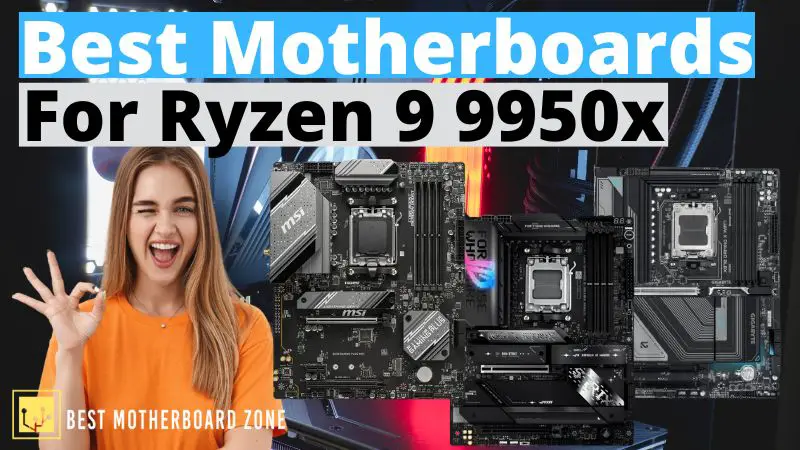
The motherboards I would shortlist for the Ryzen 9 9950X
MSI MAG X870E TOMAHAWK MAX WIFI
The sensible high-end choice when you need plenty of storage and I/O, but not specialist workstation networking.
- 4 M.2 slots with two Gen5 positions
- Dual USB4, 5GbE, Wi-Fi 7 and ALC4080 audio
- Limitation: the second Gen5 M.2 slot shares bandwidth with USB4
ASRock X870 Taichi Creator
The board to buy when the 9950X is feeding a genuine workstation with fast network storage, multiple PCIe devices and high-speed external hardware.
- 10GbE + 5GbE, Wi-Fi 7 and dual USB4
- Dual Gen5 M.2 + dual PCIe 5.0 x16 physical slots
- Limitation: the second Gen5 M.2 slot shares bandwidth with USB4
MSI PRO X870-P WIFI
The sensible alternative if you need the 9950X’s 16 cores but the rest of the PC is much simpler than a full workstation.
- Gen5 GPU + Gen5 M.2, USB4 and 5GbE
- Wi-Fi 7 and three onboard M.2 slots
- Limitation: less expansion and more basic onboard audio than the two higher-end picks
Compare the best Ryzen 9 9950X motherboards
Swipe → to see the full comparison
| Motherboard | M.2 | Ethernet | USB4 | Expansion | Best for | Check |
|---|---|---|---|---|---|---|
| MSI X870E TOMAHAWK MAX |
4 2 × Gen5 |
5GbE | 2 × 40Gbps | Gen5 x16 GPU + additional PCIe | Balanced high-end build | Amazon → |
| ASRock X870 Taichi Creator |
4 2 × Gen5 |
10GbE + 5GbE | 2 × 40Gbps | 2 × Gen5 x16 physical slots, x16 or x8/x8 | Creator workstation | Amazon → |
| MSI PRO X870-P WIFI |
3 1 × Gen5 |
5GbE | 1 × 40Gbps | Gen5 x16 GPU | Simpler / value-focused build | Amazon → |
Does the Ryzen 9 9950X require X870E?
No.
AMD supports the Ryzen 9 9950X on a wide range of AM5 chipsets. That includes older 600-series boards as well as the newer 800-series family.
A higher-tier chipset mainly changes what the motherboard manufacturer can expose in terms of PCIe lanes, USB, networking and expansion.
It does not unlock additional cores or make the same CPU inherently faster at stock settings.
Do not choose the chipset by CPU price
A Ryzen 9 9950X can justify an expensive motherboard because the workstation around it may need a lot of storage and I/O.
That is very different from saying an expensive processor automatically needs AMD’s most expensive chipset.
When X870E makes sense
X870E becomes useful when you need more PCIe and high-speed I/O flexibility: several M.2 drives, multiple expansion cards, fast networking and a lot of external high-bandwidth hardware.
When X870 is enough
X870 is already a strong platform for many 9950X systems. You get PCIe 5.0 graphics capability, Gen5 NVMe, USB4 and CPU/memory overclocking without automatically paying for an expansion-heavy motherboard.
When B850 can still make sense
Even B850 can be appropriate if the exact board has suitable power delivery and the features your build requires.
For a simple one-GPU system, there is no requirement that a 16-core CPU must sit on X870E.
The three Ryzen 9 9950X motherboard picks in detail
1. MSI MAG X870E TOMAHAWK MAX WIFI
This is where I would start if I were building a new Ryzen 9 9950X workstation that still needs to behave like an ordinary desktop rather than a specialized professional platform.
Four M.2 positions give you plenty of storage flexibility. With the 9950X installed, the first two slots can operate at PCIe 5.0 x4, while the other two provide Gen4 x4 connections through the chipset. Four SATA ports remain available as well.
That makes it easy to build around a fast OS/applications SSD, a separate project drive and additional local storage without immediately relying on PCIe add-in cards.
Networking is 5Gb Ethernet plus Wi-Fi 7. For a lot of home and small-office workstations, 5GbE is already a useful step beyond the common 2.5Gb connection without paying specifically for 10Gb networking hardware.
Rear I/O includes two 40Gbps USB4 Type-C ports, while MSI also provides ALC4080 audio, Clear CMOS, BIOS Flashback, four debug LEDs and a digital diagnostic display.
Those troubleshooting features are worth more on a 9950X system than decorative extras because the kind of user buying this CPU is more likely to tune memory, change BIOS settings and upgrade the machine later.
The second Gen5 M.2 slot and USB4 share bandwidth
If you populate M2_2, MSI splits the CPU link between that M.2 connection and the USB4 controller.
Both operate at x2 by default. You can change M2_2 to x4 in BIOS, but doing so disables the rear USB4 ports.
This does not make the board a bad choice. It means a buyer choosing it specifically for multiple high-speed devices needs to plan those devices before ordering.
Buy it if: you want four onboard NVMe positions, fast networking, dual USB4 and excellent diagnostic features without building a specialized workstation.
Skip it if: 10Gb networking or multiple CPU-connected x8 expansion devices are central to your workflow.
2. ASRock X870 Taichi Creator
This is exactly the kind of motherboard where paying more can make sense around a Ryzen 9 9950X.
Not because the CPU performs better on an expensive board, but because the Taichi Creator exposes hardware a real workstation can use.
Networking is the most obvious example. You get a dedicated 10Gb Ethernet connection plus a second 5Gb Ethernet port, alongside Wi-Fi 7.
If your editing, development or production workflow constantly moves large files between the PC and a fast NAS or server, that can affect the system every day. For someone with a 1Gb home network, most of that value disappears.
Expansion is equally interesting. Two CPU-connected PCIe 5.0 x16-size slots can operate as x16 for one device or x8/x8 when both are populated.
That creates space for configurations such as a GPU plus a second accelerator or another high-bandwidth card without reducing the whole workstation to chipset-connected expansion.
Storage consists of two Gen5 x4 M.2 slots, one Gen4 x4 slot and one Gen3 x4 position, plus four SATA connectors.
You also get dual 40Gbps USB4 Type-C ports and ALC4082 onboard audio.
High-end connectivity still involves lane sharing
When the second Gen5 M.2 slot is populated, it shares bandwidth with the USB4 controller. Both operate at x2 unless you give M2_2 its full x4 link in BIOS — which disables both rear USB4 ports.
The fourth M.2 slot also shares resources with the lower chipset PCIe slot. If you are buying this board specifically because you intend to populate nearly every connector, read the bandwidth table first.
Buy it if: the 9950X will sit in a real production workstation with 10Gb networking, multiple high-bandwidth PCIe devices or lots of external storage.
Skip it if: one GPU, three SSDs and 2.5/5Gb networking already cover everything you intend to connect.
3. MSI PRO X870-P WIFI
The PRO X870-P is here because not every person who buys a 16-core CPU also needs an expensive workstation motherboard.
You might compile code, render occasionally or run demanding applications while still having a fairly conventional desktop configuration: one graphics card, two or three SSDs and a standard network.
In that situation, this board covers the fundamentals surprisingly well.
The 9950X gets a PCIe 5.0 x16 graphics connection and a CPU-connected Gen5 x4 M.2 slot. Two more M.2 positions handle additional storage. There are also four SATA ports.
Connectivity includes a 40Gbps USB4 Type-C connection, another 20Gbps rear Type-C connection, 5Gb Ethernet and Wi-Fi 7.
What you do not get is the more elaborate expansion of the Taichi Creator, four M.2 positions, dual USB4 or 10Gb networking.
The onboard audio is also the more basic ALC897 implementation. If you use USB audio, an external interface or HDMI/DisplayPort audio, that may have little relevance to the purchase.
Buy it if: you need the 9950X’s CPU performance but the rest of the PC is still relatively straightforward.
Skip it if: you will actually use four NVMe drives, 10Gb networking, multiple high-bandwidth add-in cards or dual USB4.
What actually matters for a Ryzen 9 9950X motherboard
1. Sustained CPU workloads matter more here than on a gaming-only CPU
The 9950X has a 170W default TDP and is exactly the kind of processor people buy for sustained all-core workloads.
That means motherboard power delivery and VRM cooling deserve genuine attention.
But that still does not mean counting phases and choosing whichever motherboard has the largest number.
Power-stage capability, component quality, heatsink design, airflow and actual thermal behavior all matter together.
Once the board comfortably handles the CPU under your workload, additional VRM hardware mainly gives you more thermal or overclocking headroom rather than automatically making a stock 9950X faster.
2. Workstation networking can be more valuable than a larger VRM
If your projects live on a fast NAS, moving from 2.5GbE to 10GbE can affect your workflow every day.
That is why the Taichi Creator’s 10GbE + 5GbE configuration matters.
If all your storage is local and your network is 1Gb, however, paying for that capability accomplishes very little.
3. Count your PCIe devices before choosing X870E
A creator workstation might need:
- a graphics card
- capture hardware
- a second compute accelerator
- high-speed network hardware
- storage/HBA cards
- professional audio hardware
Those requirements can justify additional CPU and chipset lane flexibility.
If you have one GPU and no other major add-in device, a large part of that expansion capability may never be used.
4. Three M.2 slots may already be enough
Workstation does not automatically mean five SSDs.
One OS/applications drive, one active-project drive and one bulk local storage SSD already gives you a very capable three-drive setup.
Buy four or five onboard M.2 positions when your workflow genuinely needs them rather than because the specification looks more future-proof.
5. Read the lane-sharing table before filling every slot
This becomes especially important on high-end motherboards.
Manufacturers can expose many Gen5 connections, but the CPU still has a finite number of PCIe lanes.
It is therefore common for secondary Gen5 M.2 slots, USB4 controllers and PCIe expansion slots to share bandwidth.
If a motherboard’s reason for being on your shortlist is that you intend to populate most of those connectors, read the manual before ordering it.
6. Do not use maximum advertised DDR5 speed as the buying criterion
AMD officially rates the 9950X for DDR5-5600 with common two-DIMM configurations.
Much higher motherboard figures are memory-overclocking capabilities, not the speed you need to run.
Stability depends on the CPU memory controller, DIMMs, rank configuration, capacity, number of populated slots and BIOS.
For a production workstation, a stable 64GB or 128GB configuration can be far more valuable than chasing the largest memory-frequency number printed on the motherboard box.
7. Four populated DIMMs change the memory load
AMD’s official specification drops the supported memory rate when four DIMMs are populated.
That does not mean four-DIMM builds are unusable. It means that very high-capacity workstation memory and extreme memory speed are competing goals.
If you need 64GB or 128GB, two large DIMMs are often the cleaner starting point. Check the exact board’s memory QVL for unusual high-capacity configurations.
8. CPU cooling deserves budget before luxury motherboard features
AMD does not include a cooler with the Ryzen 9 9950X and recommends liquid cooling for optimal performance.
A motherboard with more decorative hardware does not compensate for inadequate CPU cooling.
Make sure the case and cooler can sustain the processor’s workload before moving motherboard money into features the build may never use.
Already own a good AM5 motherboard?
You may only need a BIOS update
AMD lists the 9950X as compatible with older AM5 chipset families as well as current 800-series boards.
If you already own a good B650E, X670 or X670E board, check the manufacturer’s CPU-support page and required BIOS version before replacing it.
If the existing board already provides the storage, networking, expansion and power delivery you need, moving to X870 simply because it is newer may add little to the finished system.
What I would avoid
Do not buy a $500 motherboard to prove the CPU is high-end
An expensive motherboard can absolutely make sense with the Ryzen 9 9950X.
But the justification should be specific:
- I need 10Gb networking.
- I need x8/x8 PCIe expansion.
- I need four NVMe drives.
- I need multiple USB4 devices.
- I need more diagnostic or overclocking controls.
If you cannot identify the feature you are paying for, a simpler motherboard will often run the same 9950X perfectly well.
The Ryzen 9 9950X motherboard decision in 30 seconds
High-end all-round build
Choose the MSI X870E TOMAHAWK MAX when four M.2 slots, dual USB4 and 5Gb networking cover the workstation.
Serious creator workstation
Choose the ASRock X870 Taichi Creator when 10GbE, a second 5GbE port and x8/x8 PCIe expansion are useful.
Simpler one-GPU workstation
Choose the MSI PRO X870-P WIFI when three SSDs, USB4 and 5GbE already cover the build.
Already own AM5?
Check the existing motherboard’s CPU-support list before replacing it. A BIOS update may be all you need.
Continue your Ryzen 9 9950X build
Ryzen 9 9950X motherboard FAQ
What is the best motherboard for the Ryzen 9 9950X?
For a balanced high-end build, I would start with the MSI MAG X870E TOMAHAWK MAX WIFI. It provides four M.2 slots, dual USB4, 5Gb Ethernet and useful diagnostic features without requiring specialist workstation networking.
Does the Ryzen 9 9950X need X870E?
No. AMD supports the 9950X across several AM5 chipset families. Choose X870E when its additional expansion and connectivity benefit the system you are actually building.
Can I use B850 with the Ryzen 9 9950X?
Yes, provided the exact B850 motherboard supports the processor and has appropriate power delivery and cooling for your workload. B850 itself does not prevent the 9950X from operating normally.
Can I use an older B650 or X670 motherboard?
Potentially, yes. AMD lists both chipset families as supported. Check the exact motherboard manufacturer’s CPU-support list and install the required BIOS before replacing the board.
Does the 9950X require DDR5-8000?
No. AMD’s official memory specification is DDR5-5600 with common two-DIMM configurations. Much higher motherboard numbers refer to overclocking capability, not a requirement for the CPU.
How much RAM should I use with the Ryzen 9 9950X?
32GB can still be enough for gaming and general use, but 64GB is a more natural starting point for many systems built specifically around a 16-core productivity processor. 96GB, 128GB or more may make sense for large media projects, virtual machines and memory-heavy workloads.
Is 10Gb Ethernet worth paying for?
It can be extremely useful when the workstation regularly moves large project files to and from a compatible NAS or server. It provides little benefit when the rest of the network is limited to 1Gb or 2.5Gb.
Do I need four or five M.2 slots?
Not necessarily. Three onboard M.2 drives already provide plenty of storage flexibility for many users. Four or more make more sense for project, scratch, dataset and local-media workloads.
Does the Ryzen 9 9950X need liquid cooling?
AMD recommends liquid cooling for optimal performance. Whatever cooling approach you choose should be sized for sustained 170W-class workloads and fit the case you plan to use.
Is the Taichi Creator worth it over the X870E Tomahawk?
It is worth considering if you can use its 10Gb + 5Gb dual networking, x8/x8 CPU-connected PCIe expansion or creator-focused connectivity. If those features would sit unused, the Tomahawk is the more balanced purchase.
Specification references
CPU and motherboard specifications were checked against current AMD and manufacturer documentation. Exact features can vary by BIOS, motherboard revision and region, so verify the exact model before purchasing.

- Best RTX 5060 Graphics Cards in 2026: 5 Models Compared - September 30, 2026
- MSI X870 Tomahawk vs B850 Tomahawk MAX: Which Should You Buy? - September 29, 2026
- RTX 5060 Ti 8GB vs 16GB: Which Should You Buy in 2026? - September 25, 2026